typerbole-0.0.0.1: README.md
# typerbole
Parameterized typesystems, lambda cube typeclasses, and typechecking interfaces.
## Parameterized Typesystems
Like how datatypes such as `List a` (`[a]`), `Set a`, `Tree a` etc. in haskell have a parameter for a contained type, this library is based on the idea that a datatype that represents expressions can have a parameter for a typesystem.
### An Example: The Lambda Calculus
As an example, we can put together a datatype that represents the syntax for the Lambda Calculus:
```haskell
data LambdaTerm c v t =
Variable v -- a variable bound by a lambda abstraction
| Constant c -- a constant defined outside of the term
| Apply (LambdaTerm c v t) (LambdaTerm c v t) -- an application of one term to another
| Lambda (v, t) (LambdaTerm c v t) -- A lambda abstraction
```
This datatype has 3 parameters. The first two parameters represent constants and variables respectively, what's important is the final parameter `t` which is the parameter for the typesystem being used.
We can use the typesystem `SimplyTyped` in `Compiler.Typesystem.SimplyTyped` as the typesystem to make this a simply-typed lambda calculus, or we could slot in `SystemF`, `SystemFOmega`, `Hask`, to change the typesystem associcated with with it.
Sadly there's no magic that builds typecheckers for these (yet). Instead, using the language extensions `MultiParamTypeClasses` and `FlexibleInstances` and the `Typecheckable` typeclass from `Control.Typecheckable` we write a typechecker for each of these occurences.
```haskell
instance (...) => Typecheckable (LambdaTerm c v) (SimplyTyped m) where
...
instance (...) => Typecheckable (LambdaTerm c v) (SystemF m p) where
...
instance (...) => Typecheckable (LambdaTerm c v) (SystemFOmega m p k) where
...
-- and so on.
```
Or we can just ignore it all and turn it into an untyped lambda calculus:
```haskell
type UntypedLambdaTerm c v = LambdaTerm c v ()
```
## The Lambda Cube
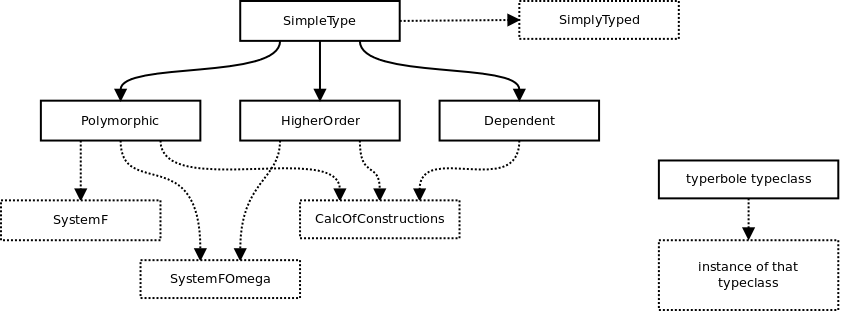
The lambda cube describes the properties of a number of typesystems, an overview can be found [**here**](./lambdacube-overview.md). It is the basis for the library's classification of typesystems, a typeclass hierarchy where each axis is represented by a typeclass whose methods and associated types are indicitive of the properties of the axis.
***
### Supported lambda-cube axies
- [x] Simply-typed lambda calculus
- [x] Polymorphic lambda calculus
- [x] Higher-order lambda calculus
- [x] Dependently-typed lambda calculus (dubiously, not got a implemented typesystem to back it up)
### TODOs
- [ ] Give `Calculi.Lambda.Cube.Polymorphic.Unification` better documentation (incl. diagrams for graph-related functions/anything that'll benefit).
- [ ] Finish the `Typecheckable` & `Inferable` instances for the typesystems in `Compiler.Typesystem.*`
- [ ] Put together a working travis file.
- [ ] Implement a Calculus of Constructions typesystem.
- [ ] Document the type expression psudocode
- [ ] Design a typeclass for typesystems with constraints (`Num a => ...`, `a ~ T` etc).
- [ ] Provide a default way of evaluating lambda expressions.
- [ ] Make the quasiquoters use the lambda cube typeclasses instead of specific typesystem implementations.
- [ ] Subhask-style automated test writing.
- [ ] Explore homotopy type theory
- [ ] Remove all extensions that aren't light syntactic sugar from `default-extensions` and declare them explicitly in the modules they're used.
- [ ] Listen to `-Wall`
- [ ] Move `Control.Typecheckable` to it's own package.
- [ ] Elaborate on the `Typecheck` type. Maybe make it a typeclass.
### Papers, Sites and Books read during development
* Introduction to generalized type systems, Dr Henk Barendregt (Journal of Functional Programming, April 1991)
* A Modern Perspective on Type Theory [(x)](https://www.amazon.co.uk/Modern-Perspective-Type-Theory-Origins/dp/1402023340)
* A proof of correctness for the Hindley-Milner type inference algorithm, Dr Jeff Vaughan [(x)](http://www.jeffvaughan.net/docs/hmproof.pdf)
* Compositional Type Checking for Hindley-Milner Type Systems with Ad-hoc Polymorphism, Dr. Gergő Érdi [(x)](https://gergo.erdi.hu/elte/thesis.pdf)
* Many wikipedia pages on type theory.