Telescope
=========
[](https://hackage.haskell.org/package/telescope)
Haskell library to read and write Astronomical images from telescopes
* [FITS](https://fits.gsfc.nasa.gov/fits_standard.html) (Flexible Image Transport System) Files
* [ASDF](https://asdf-standard.readthedocs.io/) (Advanced Scientific Data Format) Files
FITS Example
-------
```
import Telescope.Fits
import Data.ByteString qualified as BS
main :: IO ()
main = do
inp <- BS.readFile "hubble.fits"
fits <- decode inp
```
FITS files start with a primary *Header Data Unit*
```
print fits.primaryHDU
```
```
DataHDU
Header: 490 records
data: 0 bytes
dimensions:
format: Int8
axes: []
```
HDUs may contain both data and a *header*
```
print fits.primaryHDU.header
```
```
SIMPLE = T / conforms to FITS standard
BITPIX = 8 / array data type
NAXIS = 0 / number of array dimensions
EXTEND = T
DATE = '2009-11-10' / date this file was written (yyyy-mm-dd)
FILETYPE= 'SCI' / type of data found in data file
TELESCOP= 'HST' / telescope used to acquire data
INSTRUME= 'WFPC2' / identifier for instrument used to acquire data
EQUINOX = 2000.0 / equinox of celestial coord. system
...
```
The primary HDU is followed by multiple extensions in a similar format
```
mapM_ print fits.extensions
```
```
Image: DataHDU
Header: 103 records
data: 12960000 bytes
dimensions:
format: Float
axes: [1800,1800]
Image: DataHDU
Header: 124 records
data: 12960000 bytes
dimensions:
format: Float
axes: [1800,1800]
Image: DataHDU
Header: 123 records
data: 12960000 bytes
dimensions:
format: Int32
axes: [1800,1800]
```
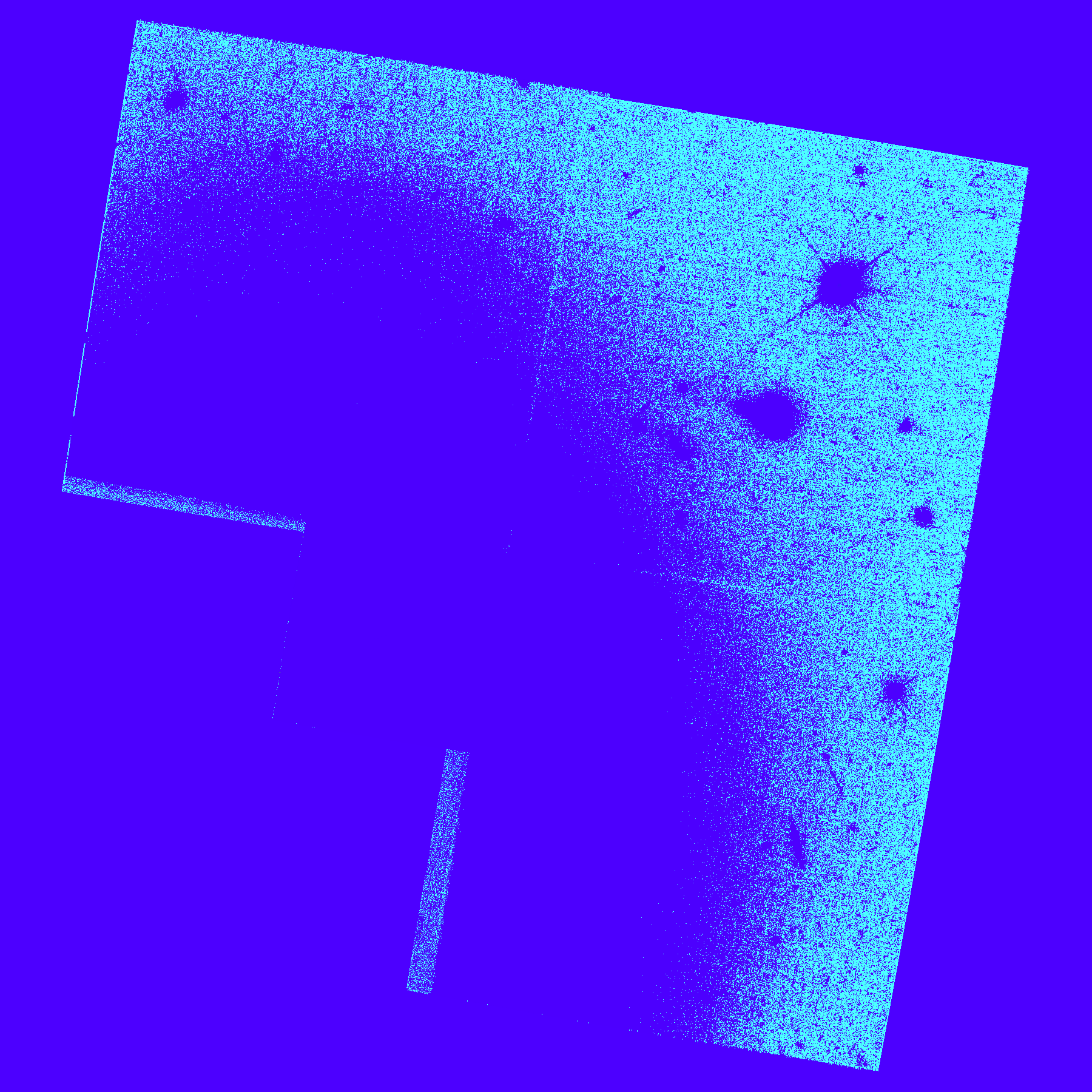
We can use `Array` from [Data.Massiv](https://hackage.haskell.org/package/massiv) to parse, manipulate, and display data
```
Image img : _ <- pure fits.extensions
arr <- decodeDataArray @Ix2 @Float img.dataArray
writeImage "hubble1.png" (heatmap arr)
```
#### Parsing Headers
Parse header keywords into Haskell records
```
import Telescope.Fits
import Effectful
data HubbleInfo = HubbleInfo
{ telescop :: Text
, instrume :: Text
, equinox :: Float
} deriving (Generic, FromHeader, ToHeader)
main = do
...
let h = fits.primaryHDU.header
print $ lookupKeyword "INSTRUME" h
case runPureEff $ runParser $ parseHeader h of
Left e -> fail $ show e
Right info -> do
print info.telescop
print info.equinox
```
ASDF Example
------------
ASDF files contain a YAML tree and binary data afterwards. They are readable and the tree is editable in a text editor.
```
example :: IO ()
example = do
inp <- BS.readFile "../samples/dkist.asdf"
dset :: Dataset <- decodeM inp
print dset.info
data DKISTInfo = DKISTInfo
{ instrumentName :: Text
, frameCount :: Int
}
deriving (Show, Generic, FromAsdf)
data Dataset = Dataset
{ info :: DKISTInfo
}
instance FromAsdf Dataset where
-- parse .dataset.meta.inventory into DKISTInfo
parseValue val =
case val of
Object o -> do
dset <- o .: "dataset"
meta <- dset .: "meta"
info <- meta .: "inventory"
pure $ Dataset info
k -> expected "Object" k
```
```
DKISTInfo {instrumentName = "VISP", frameCount = 1960}
```
Data can be parsed directly from the YAML tree or from binary-encoded data blocks (an NDArray)
```
data Example = Example
{ foo :: Int32
, powers :: Maybe Powers
, sequence :: [Int64]
, random :: Array D Ix1 Double
}
deriving (Generic, FromAsdf)
example :: IO ()
example = do
inp <- BS.readFile "../samples/example.asdf"
ex :: Example <- decodeM inp
print ex.name
print ex.items
print $ take 30 ex.sequence
print $ take 10 $ M.toList ex.random
```
```
"Monty"
["one","two","three","four","five"]
[0,1,2,3,4,5,6,7,8,9,10,11,12,13,14,15,16,17,18,19,20,21,22,23,24,25,26,27,28,29]
[0.7842310832387069,0.2279459557291822,0.9534462812074139,0.5100515929833191,0.6597920763222204,0.8778040169160855,0.8079416746447109,0.5373925949744411,0.5169365152585088,0.436101639340324]
```
### Collaborators
* The FITS code was developed in collaboration with @krakrjak