raytrace-0.1.0.0: README.md
# raytrace
A Haskell ray tracing library. Largely based on the books [Ray Tracing in One Weekend](https://raytracing.github.io/books/RayTracingInOneWeekend.html) and [Ray Tracing: The Next Week](https://raytracing.github.io/books/RayTracingTheNextWeek.html) by Peter Shirley.
Features:
* Spheres, parallelograms, and boxes (you can define your own shapes in addition to these)
* Volumes (fog and the like)
* A variety of materials, with behaviors including light emission and refraction
* Texture mapping
* Perlin noise for procedurally generated textures
* Parallel computation of pixels
* Bounding volume hierarchies
* Affine transformations (rotation, translation, and so on)
* Optional defocusing to simulate a real camera lens
Possible future additions:
* Motion blur
* Triangular meshes
* Less noise in scenes with small light sources
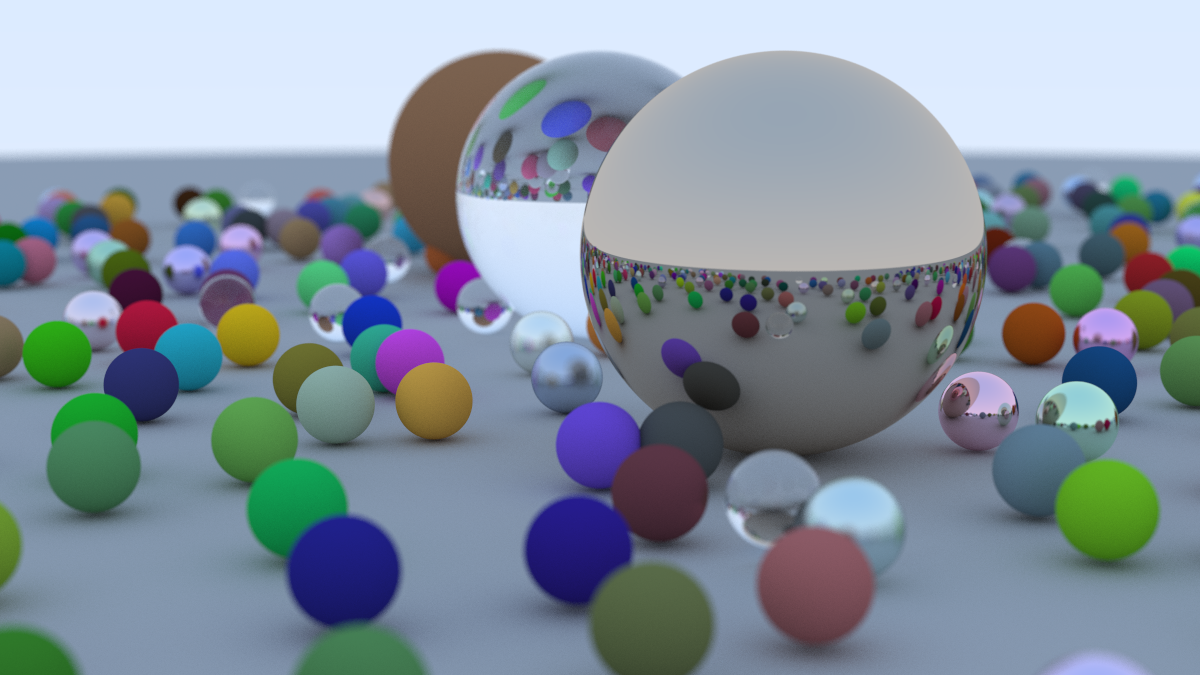
The image above, with 405 million top-level rays, was generated on my laptop in about 8 minutes. The blurriness in the foreground and background is due to defocusing, wherein only a single plane is in focus. The following image demonstrates texture mapping, light sources, and fog:
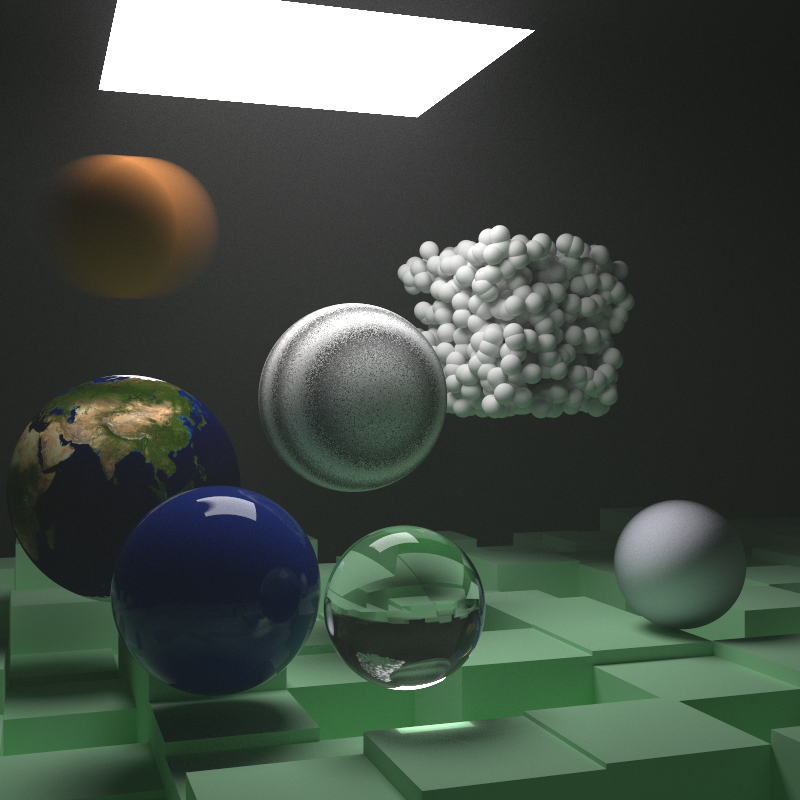
(The code for both of these images was based on code in the aforementioned books.)
## Example Usage
```haskell
module Main where
import Graphics.Ray
import Linear (V3(V3))
import System.Random (newStdGen)
import Data.Functor.Identity (Identity)
world :: Geometry Identity Material
world = group
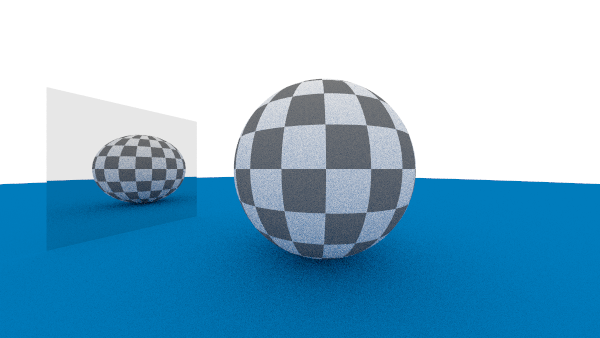
[ lambertian (checkerTexture 20 10 0.2 0.8) <$ sphere (V3 0 0 0) 1
, lambertian (constantTexture (V3 0 0.2 0.5)) <$ sphere (V3 0 (-1000) 0) 999
, mirror (constantTexture 0.8) <$ parallelogram (V3 (-3.25) (-1) (-0.75)) (V3 1.25 0 (-1.25)) (V3 0 2 0)
]
settings :: CameraSettings
settings = defaultCameraSettings
{ cs_center = V3 (-0.75) 0 2
, cs_lookAt = V3 0 0 (-1)
, cs_aspectRatio = 16 / 9
, cs_imageWidth = 600
, cs_samplesPerPixel = 50
}
main :: IO ()
main = do
seed <- newStdGen
writeImage "example_image.png" (raytrace settings world seed)
```
This produces the following image: