# pure-noise
Performant, modern noise generation for Haskell with a minimal dependency footprint.
## Core features
- **algebraic composition** of noise functions. You can combine,
layer, and transform noise sources using standard operators (E.g., `Num`,
`Fractional`, `Monad`, etc).
- **Complex effects** like domain warping and multi-octave fractals with clean,
type-safe composition.
- **Competitive with C++**: roughly 70-100% of FastNoiseLite's single-threaded
random-access throughput under the LLVM backend. And 2D cellular noise runs
ahead of C++, measured against an optimized FNL build.
**For detailed FastNoiseLite comparison, methodology, and reproducibility instructions,
see the [benchmark README](https://github.com/jtnuttall/pure-noise/blob/main/bench/README.md).**
The public interface for this library is unlikely to change much, although the
implementations (`noiseBaseN` functions and anything in `Numeric.Noise.Internal`)
are subject to change and may change between minor versions.
## Acknowledgments
- This project grew from a port of the excellent
[FastNoiseLite](https://github.com/Auburn/FastNoiseLite) library. The library
structure has been tuned to perform well in Haskell and fit well with Haskell
semantics, but the core noise share their origin with FNL.
- All credit for the original design, algorithms, and implementation goes to its
creator **[Jordan Peck (@Auburn)](https://github.com/Auburn)**. I'm grateful for
their work and the opportunity to learn from it.
- The original FastNoiseLite code, from which the core algorithms in this library
were originally ported, is (C) 2020 Jordan Peck and is licensed under the MIT
license, a copy of which is included in this repository.
## FastNoiseLite compatibility
pure-noise shares its lineage with FNL, but it isn't intended as a 1:1 port —
kernels are restructured for GHC, and some families intentionally diverge.
Where outputs stand today:
| family | output vs FNL |
| ---------------------------------------- | --------------------------------------------- |
| `perlin2/3`, `cellular2/3` | bit-exact |
| `openSimplex2/3`, `superSimplex2/3` | within a few ULP |
| `value2/3`, `valueCubic2/3` | diverges (hash finalization) |
| `fractal2/3`, `ridged2/3`, `pingPong2/3` | diverges (octave normalization and weighting) |
| `billow2/3` | no FNL counterpart |
> [!IMPORTANT]
>
> The `value`, `valueCubic`, and fractal families will align with FNL in 0.3,
> which changes their output for a given seed. Pin `pure-noise < 0.3` if you
> depend on seed-stable output from them.
## Usage
The library provides composable noise functions. `Noise2` and `Noise3` are type
aliases for 2D and 3D noise. Noise functions can be composed transparently using
standard operators with minimal performance cost.
Noise values are generally clamped to `[-1, 1]`, although some noise functions
may occasionally produce values slightly outside this range.
### Basic Example
```haskell
import Numeric.Noise qualified as Noise
-- Compose multiple noise sources
myNoise2 :: (RealFrac a) => Noise.Seed -> a -> a -> a
myNoise2 =
let fractalConfig = Noise.defaultFractalConfig
combined = (Noise.perlin2 + Noise.superSimplex2) / 2
in Noise.noise2At $ Noise.fractal2 fractalConfig combined
```
### Advanced Features
The library's unified `Noise p v` type enables powerful composition patterns:
#### Complex Compositions
The `Monad` instance is useful to create noise that depends on other noise values:
```haskell
-- Use one noise function's output to modulate another
complexNoise :: Noise.Noise2 Float
complexNoise = do
baseNoise <- Noise.perlin2
detailNoise <- Noise.next2 Noise.superSimplex2
-- Blend based on base noise: smooth areas get less detail
pure $ baseNoise * 0.7 + detailNoise * (0.3 * (1 + baseNoise) / 2)
```
This is especially useful for creating organic, varied terrain where one noise pattern
influences the characteristics of another.
#### 1D Noise via Slicing
Generate 1D noise by slicing higher-dimensional noise at a fixed coordinate:
```haskell
-- Create 1D noise by fixing one dimension
noise1d :: Noise.Noise1 Float
noise1d = Noise.sliceY2 0.0 Noise.perlin2
-- Evaluate at a point
value = Noise.noise1At noise1d seed 5.0
```
**Coordinate Transformation:**
Scale, rotate, or warp the coordinate space:
```haskell
-- Double the frequency
scaled = Noise.warp (\(x, y) -> (x * 2, y * 2)) Noise.perlin2
-- Rotate 45 degrees
rotated = Noise.warp (\(x, y) ->
let a = pi / 4
in (x * cos a - y * sin a, x * sin a + y * cos a)) Noise.perlin2
```
#### Layering Independent Noise
Use `reseed` or `next2`/`next3` to create independent layers:
```haskell
layered = (Noise.perlin2 + Noise.next2 Noise.perlin2) / 2
```
More examples can be found in `bench` and `demo`.
#### Domain Warping
Domain warping uses one noise function to distort the coordinate space of another,
creating organic, flowing patterns ideal for terrain, clouds, and natural textures:
```haskell
domainWarped :: Noise.Noise2 Float
domainWarped = do
-- Generate 3D fractal for warp offsets
let warpNoise = Noise.fractal3 Noise.defaultFractalConfig{Noise.octaves = 5} Noise.perlin3
-- Sample 3D noise at different slices to create warp offsets
warpX <- Noise.sliceX3 0.0 warpNoise -- Samples at (0, x, y)
warpY <- Noise.sliceY3 0.0 warpNoise -- Samples at (x, 0, y)
-- Apply warping to base noise coordinates
Noise.warp (\(x, y) -> (x + 30 * warpX, y + 30 * warpY))
$ Noise.fractal2 Noise.defaultFractalConfig{Noise.octaves = 5} Noise.openSimplex2
```
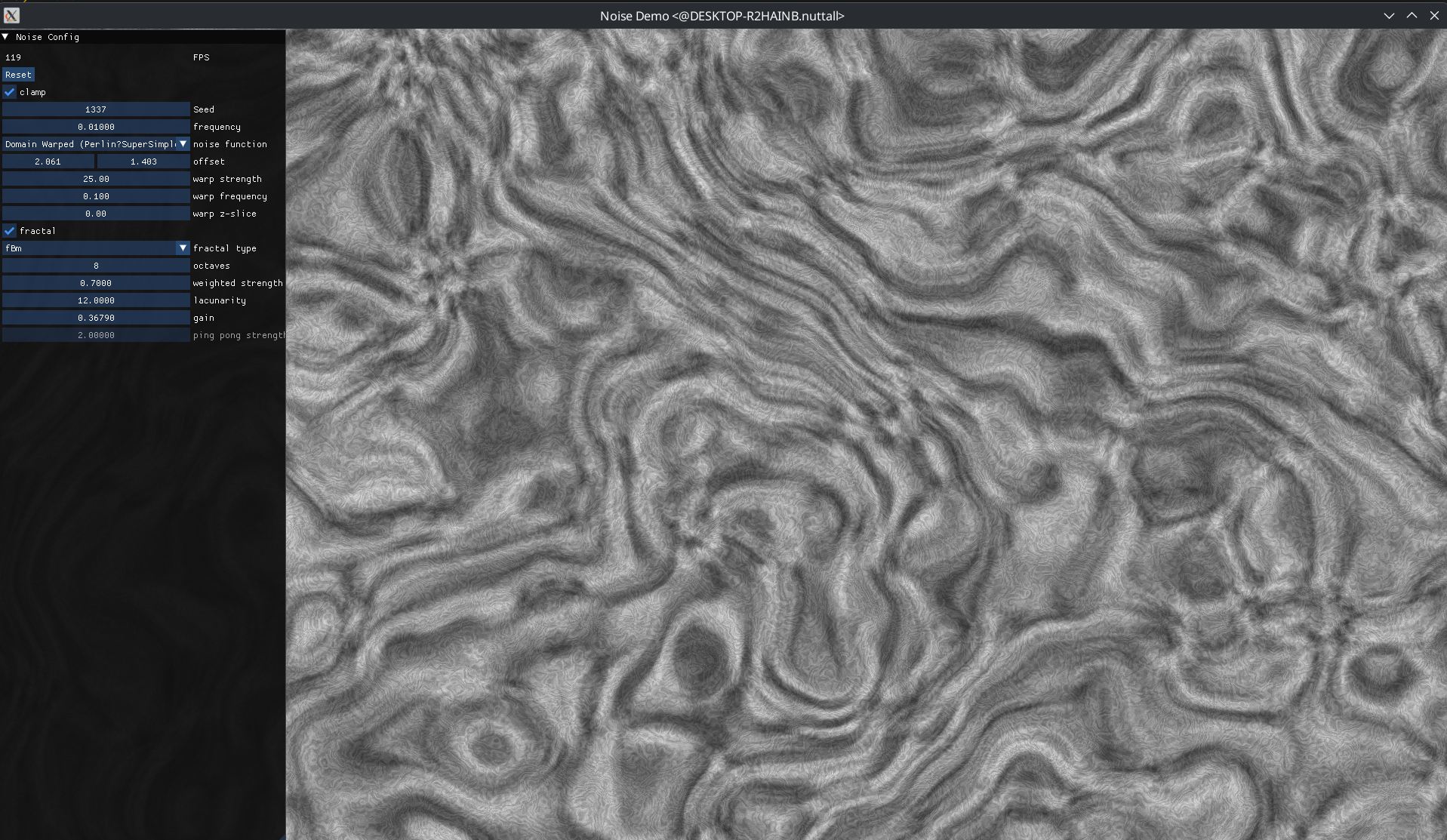
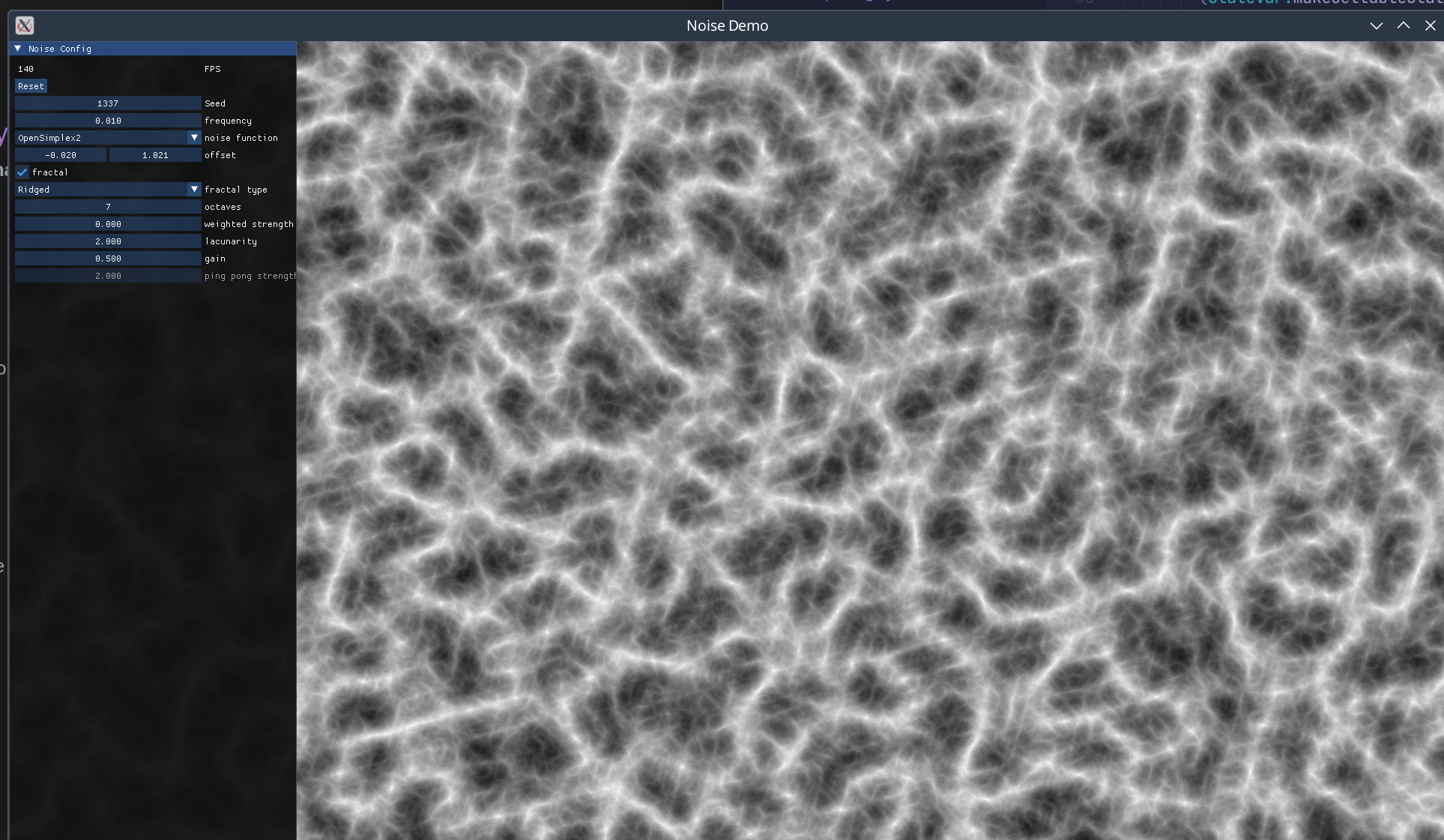
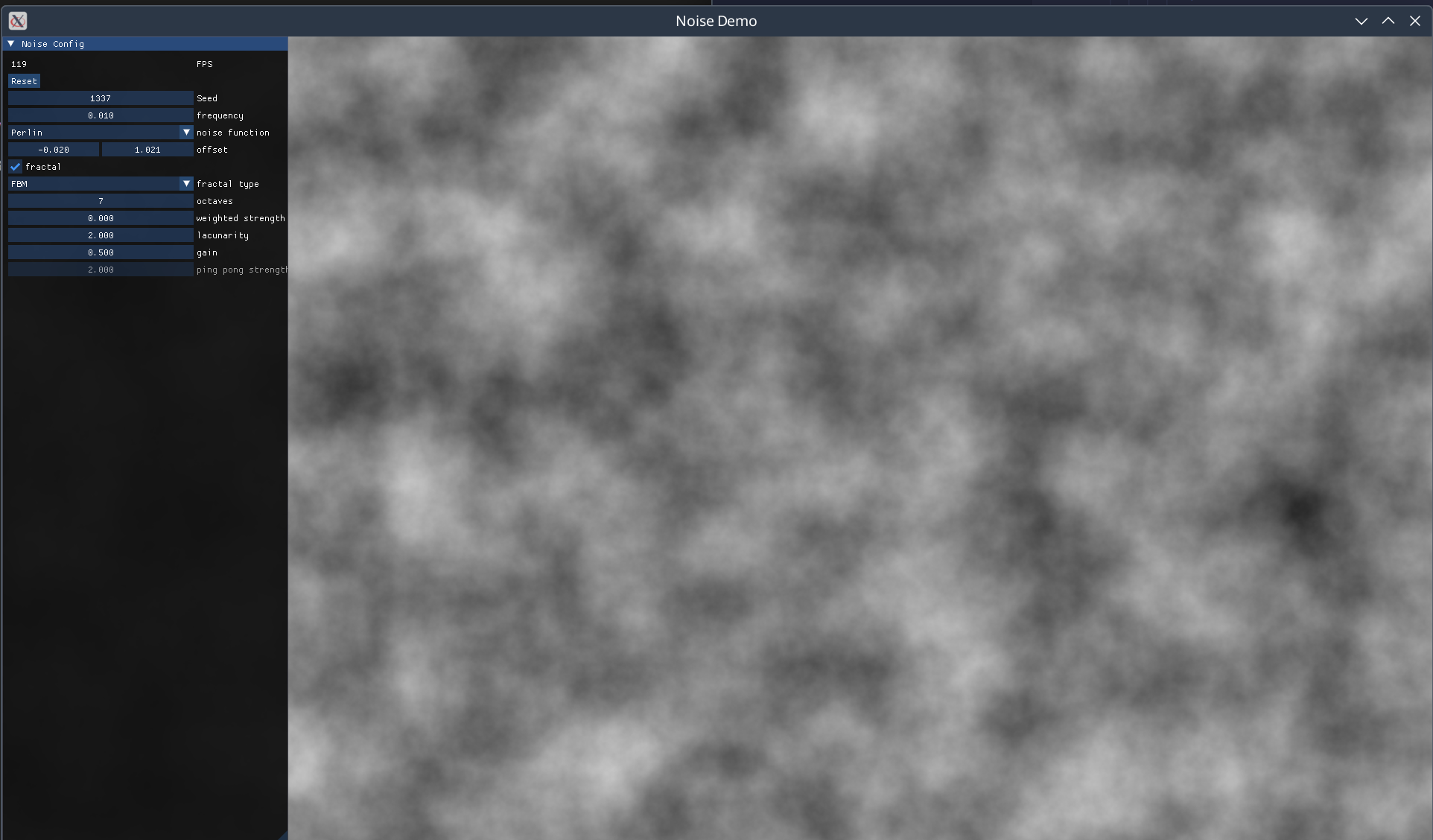
See the [demo app](demo/) for an interactive version with adjustable parameters.
## Performance notes
- In single-threaded scenarios with LLVM enabled, this library reaches
**roughly 70-100% of C++ FastNoiseLite throughput at random access, with 2D
cellular noise ~7% faster than C++**. Grid-coherent workloads measure lower
for the simplex family. These numbers are measured against an optimized
FNL build (AVX2+FMA, FP contraction on).
- This library performs significantly better under the LLVM backend
(`-fllvm`); the native code generator is not recommended where generation
speed is a real concern.
- See the [benchmark README](https://github.com/jtnuttall/pure-noise/blob/main/bench/README.md)
for per-algorithm, per-workload results and methodology.
### Recommended build flags
#### Native optimization flags for the library
For the library itself, copy `cabal.project.local.template` into your project
(`+optimize` is on by default; `+mfma +mavx` are safe on modern x86-64).
For bulk generation, prefer parallel evaluation via `massiv`.
#### Fused multiply add
For the fastest downstream executables, compile the modules that _call_ the
noise functions (the kernels inline into your code) with:
```
-fllvm -mavx -mfma -optlc-fp-contract=fast
```
> [!WARNING]
>
> 1. Results differ from a build without fma fusion by a few ULP.
> 2. Fusion decisions may vary across LLVM versions.
> Skip this flag if you need bit-identical output across builds/toolchains.
> 3. You must use `-fllvm` to use this flag. It has no effect on the native
> code generator.
`-optlc-fp-contract=fast` lets LLVM fuse multiply-add chains into FMA
instructions, an optimization modern C++ compilers apply by default. This
gives a ~5-15% improvement on these kernels in testing.
### Parallel noise generation
This library integrates well with [massiv](https://hackage.haskell.org/package/massiv)
for parallel computation. Parallel evaluation reaches roughly 6-9x
single-threaded throughput on a 14-core machine in pinned-clock measurements.
> [!IMPORTANT]
>
> Massiv integration is the recommended approach for generating large noise
> textures or datasets.
### Benchmarks
#### Results
Measured by values / second generated by the noise functions, in the
`llvm-bench` configuration (LLVM backend + FP contraction), on an i7-1370P
**pinned at 1.9 GHz** for measurement stability —
Absolute figures scale with CPU clock. The FastNoiseLite ratios are intended
to be clock-invariant.
There's inevitably some noise in the measurements because the results are forced
into an unboxed vector.
> [!NOTE]
>
> These numbers are lower than the initial release because they were re-run on a
> slower processor. Order-of-magnitude/comparative difference remains reasonably
> stable. See the benchmark README for details.
##### 2D
| name | Float (values/sec) | Double (values/sec) |
| ------------- | ------------------ | ------------------- |
| value2 | 64_407_126 | 68_260_653 |
| perlin2 | 61_301_663 | 65_143_707 |
| openSimplex2 | 25_982_291 | 27_045_472 |
| valueCubic2 | 22_743_642 | 23_403_842 |
| superSimplex2 | 17_167_069 | 17_762_669 |
| cellular2 | 16_025_950 | 16_007_044 |
##### 3D
| name | Float (values/sec) | Double (values/sec) |
| ------------- | ------------------ | ------------------- |
| value3 | 34_673_623 | 35_929_146 |
| perlin3 | 29_325_590 | 30_432_482 |
| openSimplex3 | 10_975_857 | 10_922_644 |
| superSimplex3 | 9_232_128 | 9_166_843 |
| valueCubic3 | 7_453_365 | 7_278_612 |
| cellular3 | 5_238_497 | 5_061_911 |
## Examples
There's an interactive [demo app](https://github.com/jtnuttall/pure-noise/tree/main/demo) in the `demo` directory.
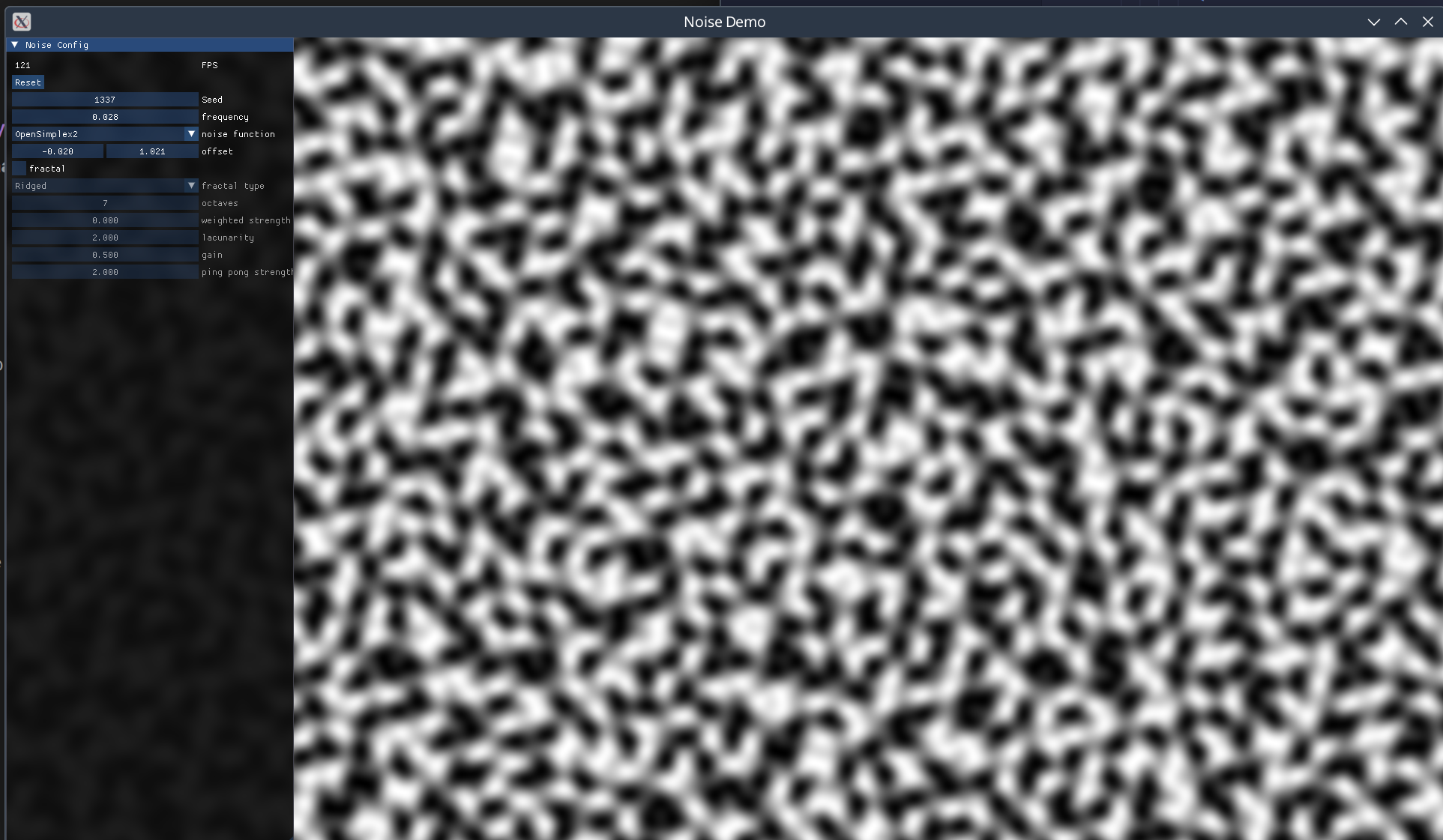
### OpenSimplex2
### Perlin
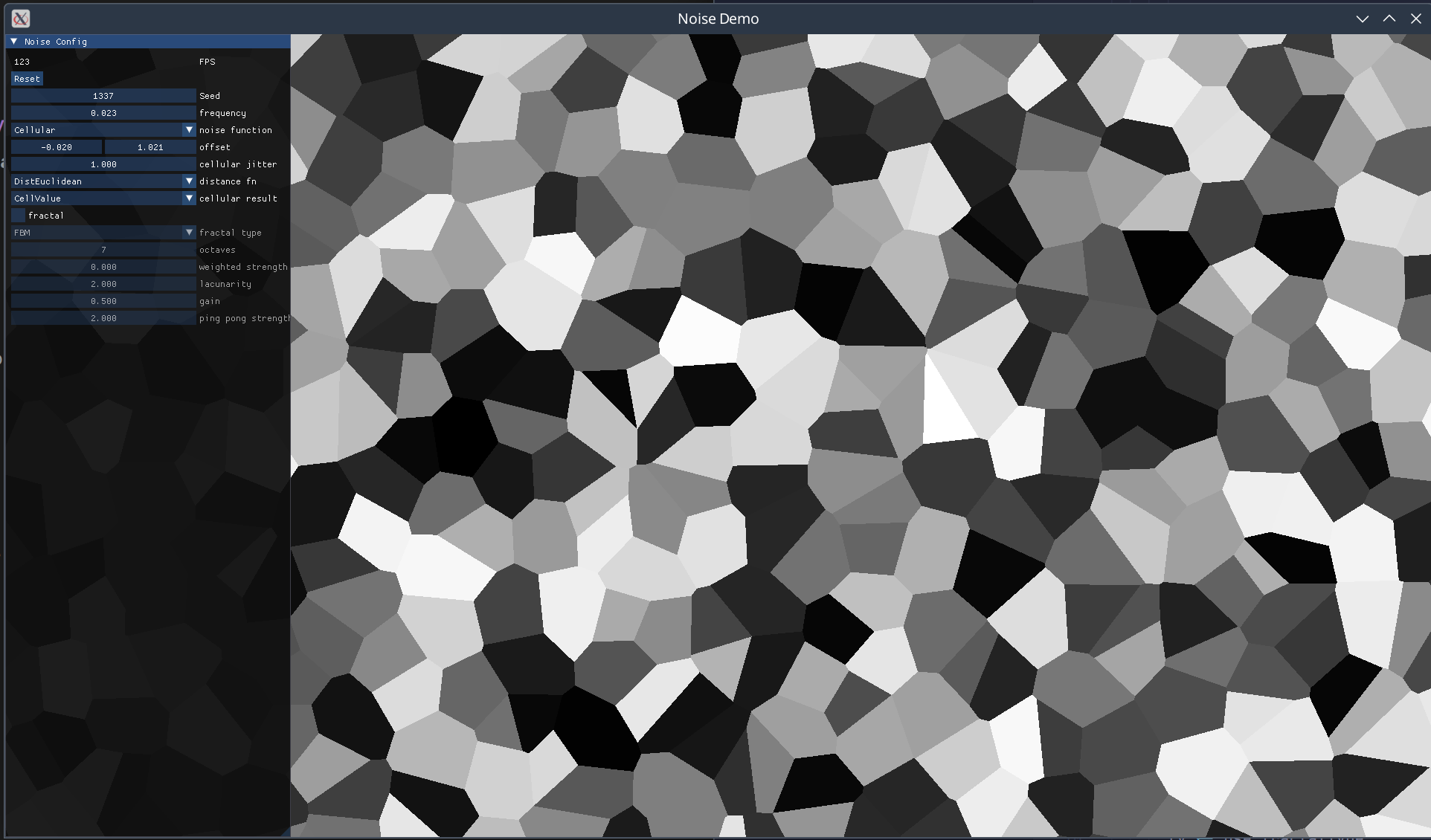
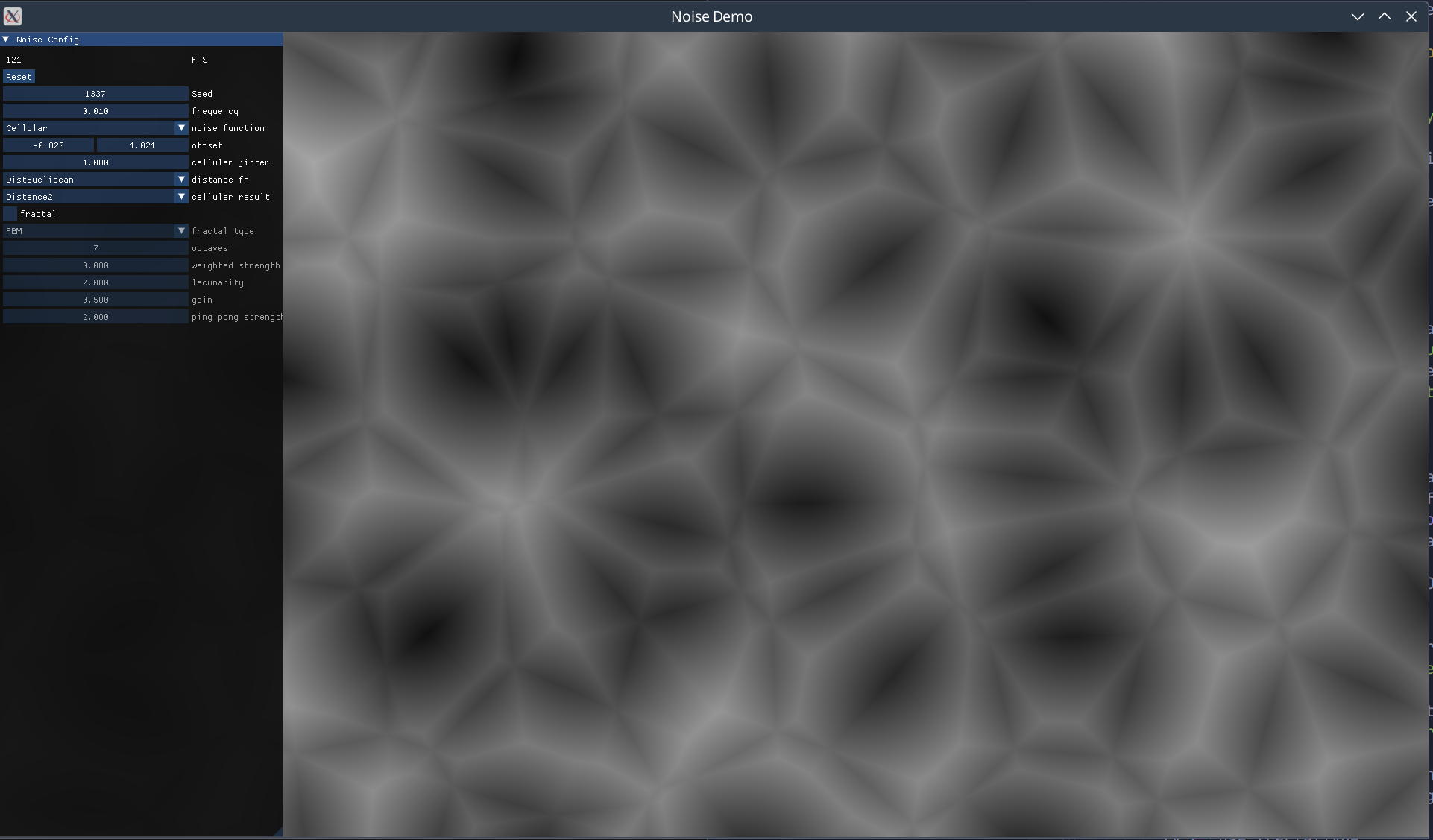
### Cellular