# pure-noise
Performant, modern noise generation for Haskell with a minimal dependency footprint.
## Core features
- **algebraic composition** of noise functions. You can combine,
layer, and transform noise sources using standard operators (E.g., `Num`,
`Fractional`, `Monad`, etc).
- **Complex effects** like domain warping and multi-octave fractals with clean,
type-safe composition.
- **84-95% of C++ FastNoiseLite performance** through aggressive optimization and
LLVM compilation.
**For detailed FastNoiseLite comparison, methodology, and reproducibility instructions,
see the [benchmark README](https://github.com/jtnuttall/pure-noise/blob/main/bench/README.md).**
The public interface for this library is unlikely to change much, although the
implementations (`noiseBaseN` functions and anything in `Numeric.Noise.Internal`)
are subject to change and may change between minor versions.
## Acknowledgments
- This project grew from a port of the excellent
[FastNoiseLite](https://github.com/Auburn/FastNoiseLite) library. The library
structure has been tuned to perform well in Haskell and fit well with Haskell
semantics, but the core noise implementations are the same.
- All credit for the original design, algorithms, and implementation goes to its
creator **[Jordan Peck (@Auburn)](https://github.com/Auburn)**. I'm grateful for
their work and the opportunity to learn from it.
- The original FastNoiseLite code, from which the core algorithms in this library
were originally ported, is (C) 2020 Jordan Peck and is licensed under the MIT
license, a copy of which is included in this repository.
## Usage
The library provides composable noise functions `Noise2` and `Noise3` are type
aliases for 2D and 3D noise. Noise functions can be composed transparently using
standard operators with minimal performance cost.
Noise values are generally clamped to `[-1, 1]`, although some noise functions
may occasionally produce values slightly outside this range.
### Basic Example
```haskell
import Numeric.Noise qualified as Noise
-- Compose multiple noise sources
myNoise2 :: (RealFrac a) => Noise.Seed -> a -> a -> a
myNoise2 =
let fractalConfig = Noise.defaultFractalConfig
combined = (Noise.perlin2 + Noise.superSimplex2) / 2
in Noise.noise2At $ Noise.fractal2 fractalConfig combined
```
### Advanced Features
The library's unified `Noise p v` type enables powerful composition patterns:
#### Complex Compositions
The `Monad` instance is useful to create noise that depends on other noise values:
```haskell
-- Use one noise function's output to modulate another
complexNoise :: Noise.Noise2 Float
complexNoise = do
baseNoise <- Noise.perlin2
detailNoise <- Noise.next2 Noise.superSimplex2
-- Blend based on base noise: smooth areas get less detail
pure $ baseNoise * 0.7 + detailNoise * (0.3 * (1 + baseNoise) / 2)
```
This is especially useful for creating organic, varied terrain where one noise pattern
influences the characteristics of another.
#### 1D Noise via Slicing
Generate 1D noise by slicing higher-dimensional noise at a fixed coordinate:
```haskell
-- Create 1D noise by fixing one dimension
noise1d :: Noise.Noise1 Float
noise1d = Noise.sliceY2 0.0 Noise.perlin2
-- Evaluate at a point
value = Noise.noise1At noise1d seed 5.0
```
**Coordinate Transformation:**
Scale, rotate, or warp the coordinate space:
```haskell
-- Double the frequency
scaled = Noise.warp (\(x, y) -> (x * 2, y * 2)) Noise.perlin2
-- Rotate 45 degrees
rotated = Noise.warp (\(x, y) ->
let a = pi / 4
in (x * cos a - y * sin a, x * sin a + y * cos a)) Noise.perlin2
```
#### Layering Independent Noise
Use `reseed` or `next2`/`next3` to create independent layers:
```haskell
layered = (Noise.perlin2 + Noise.next2 Noise.perlin2) / 2
```
More examples can be found in `bench` and `demo`.
#### Domain Warping
Domain warping uses one noise function to distort the coordinate space of another,
creating organic, flowing patterns ideal for terrain, clouds, and natural textures:
```haskell
domainWarped :: Noise.Noise2 Float
domainWarped = do
-- Generate 3D fractal for warp offsets
let warpNoise = Noise.fractal3 Noise.defaultFractalConfig{Noise.octaves = 5} Noise.perlin3
-- Extract X and Y warp offsets by slicing at z=0
warpX <- Noise.sliceX3 0.0 warpNoise
warpY <- Noise.sliceY3 0.0 warpNoise
-- Apply warping to base noise coordinates
Noise.warp (\(x, y) -> (x + 30 * warpX, y + 30 * warpY))
$ Noise.fractal2 Noise.defaultFractalConfig{Noise.octaves = 5} Noise.openSimplex2
```
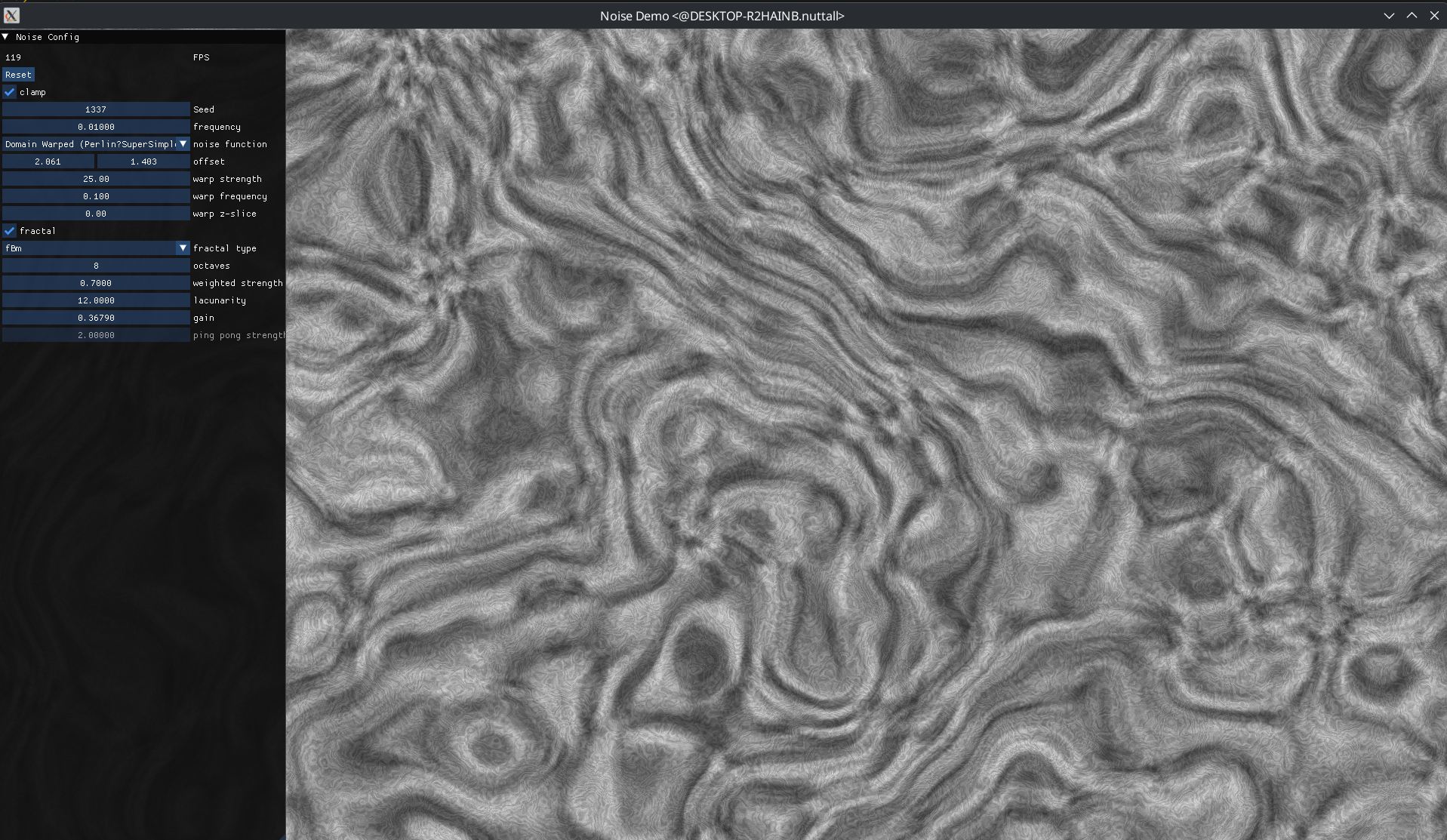
See the [demo app](demo/) for an interactive version with adjustable parameters.
## Performance notes
- In single-threaded scenarios with LLVM enabled, this library achieves **84-95%
of C++ FastNoiseLite performance**.
- This library benefits considerably from compilation with the LLVM backend
(`-fllvm`). Benchmarks suggest a ~50-80% difference depending on the kind of noise.
### Parallel noise generation
This library integrates well with [massiv](https://hackage.haskell.org/package/massiv)
for parallel computation. Parallel performance can reach 10-15x single-threaded
performance.
**This is the recommended approach for generating large noise textures or datasets.**
### Benchmarks
#### Results
Measured by values / second generated by the noise functions. These results come
from a benchmark with `-fllvm` enabled.
There's inevitably some noise in the measurements because all of the results are
forced into an unboxed vector.
##### 2D
| name | Float (values/sec) | Double (values/sec) |
| ------------- | ------------------ | ------------------- |
| value2 | 173_511_654 | 189_119_731 |
| perlin2 | 154_674_464 | 161_114_532 |
| openSimplex2 | 74_747_031 | 74_332_345 |
| valueCubic2 | 61_415_544 | 62_481_313 |
| superSimplex2 | 51_295_369 | 50_383_577 |
| cellular2 | 34_996_382 | 32_652_899 |
##### 3D
| name | Float (values/sec) | Double (values/sec) |
| ----------- | ------------------ | ------------------- |
| value3 | 90_805_572 | 93_188_363 |
| perlin3 | 74_080_032 | 82_477_882 |
| valueCubic3 | 18_765_912 | 18_284_749 |
## Examples
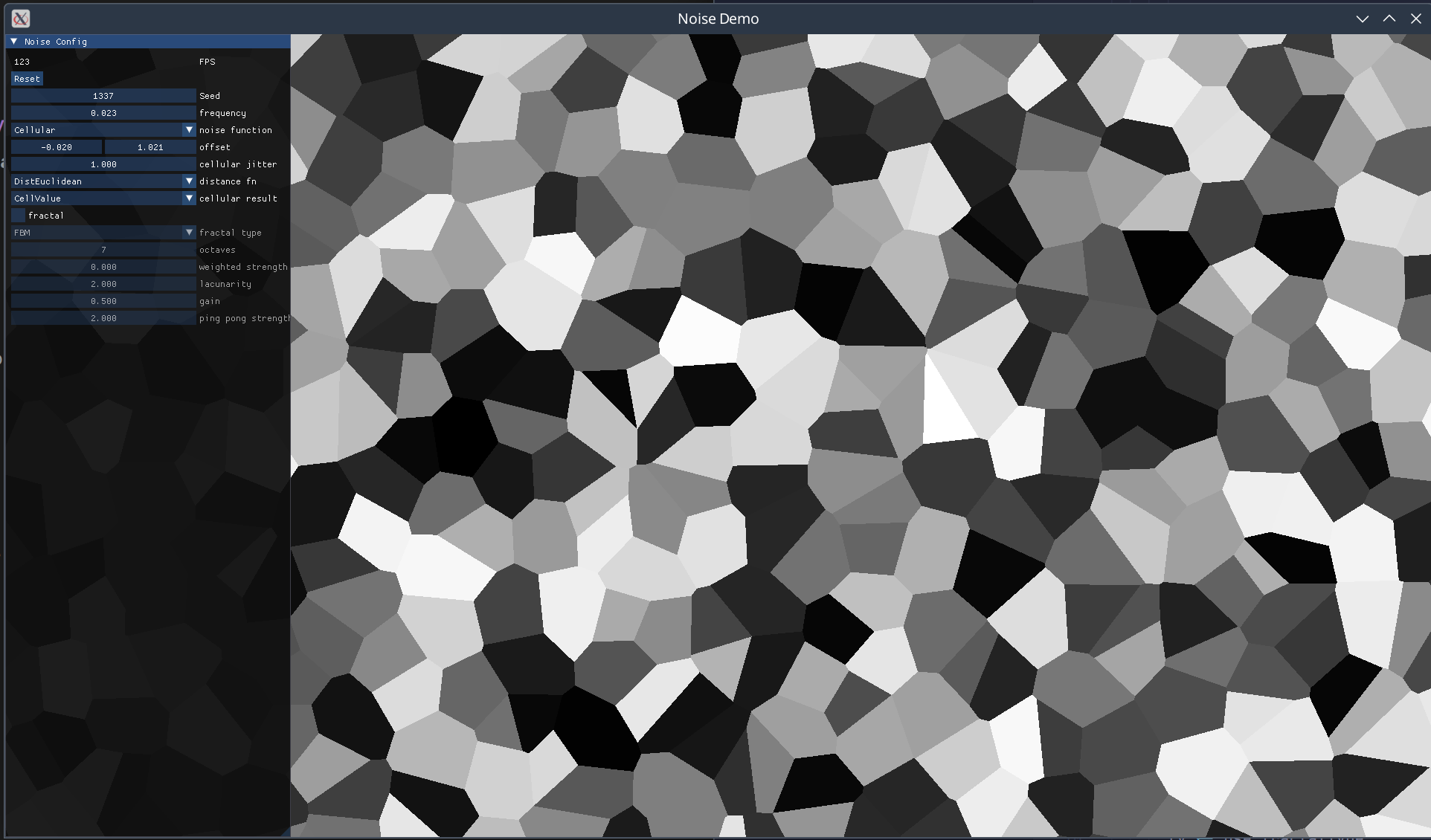
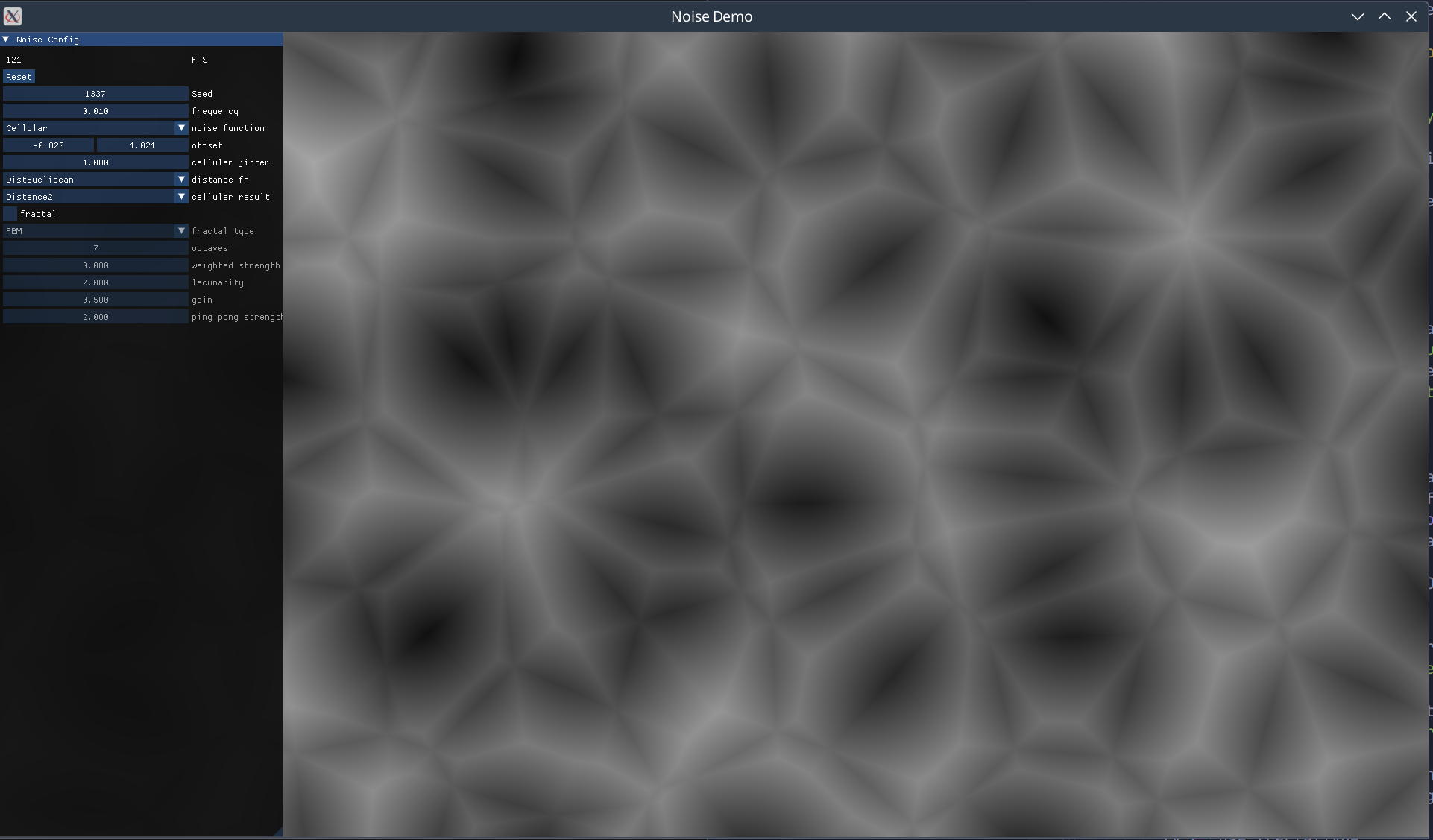
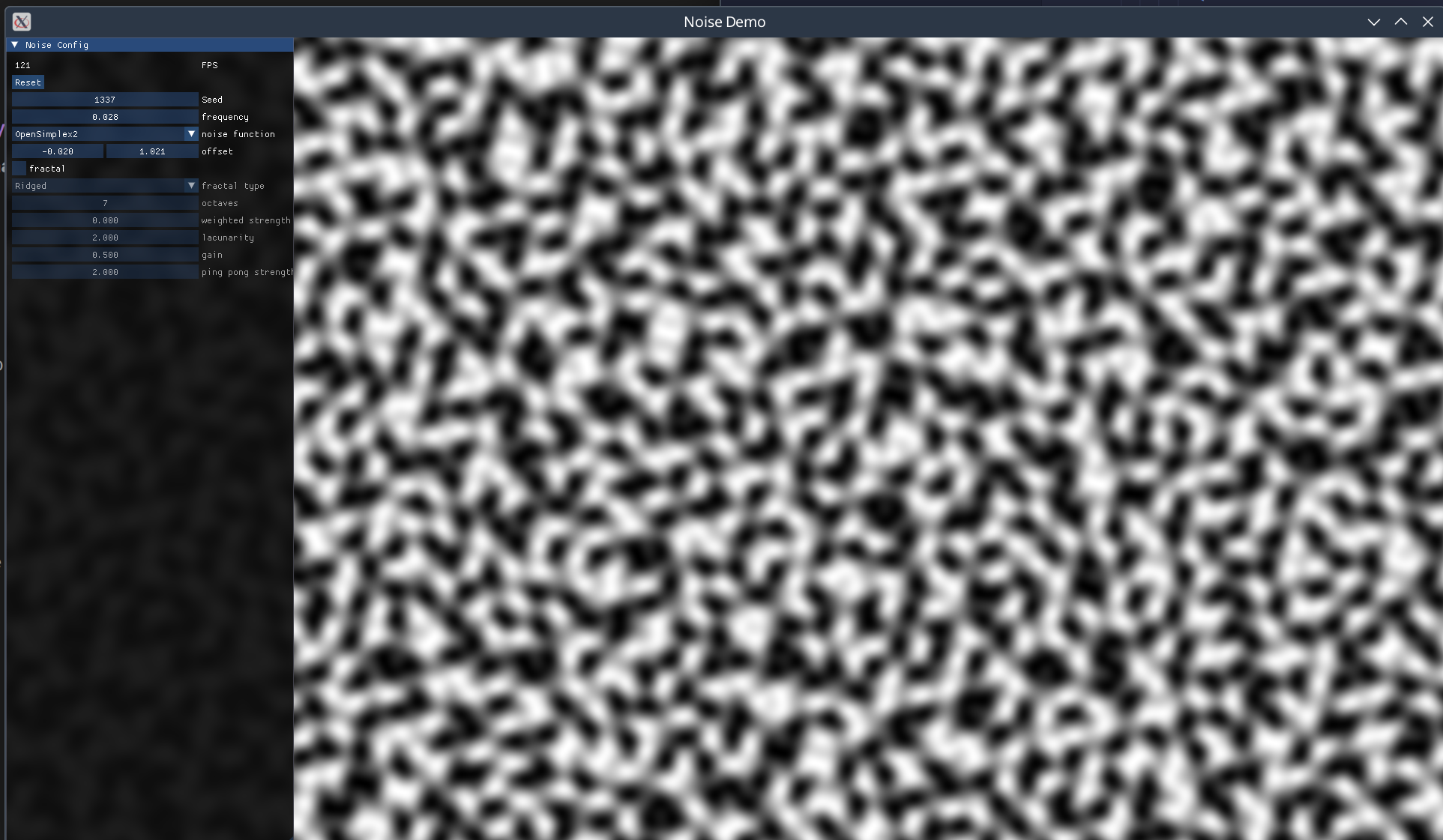
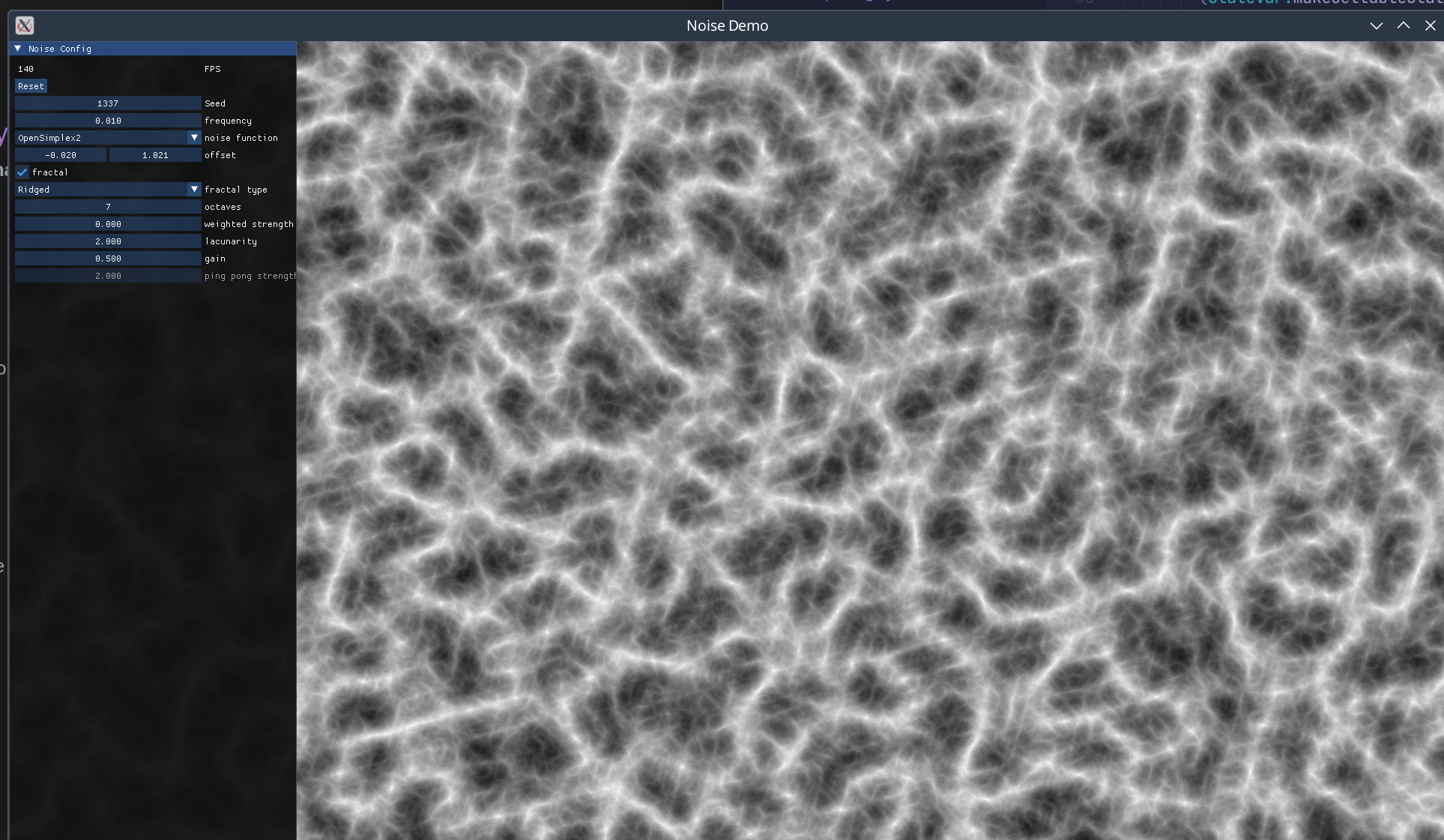
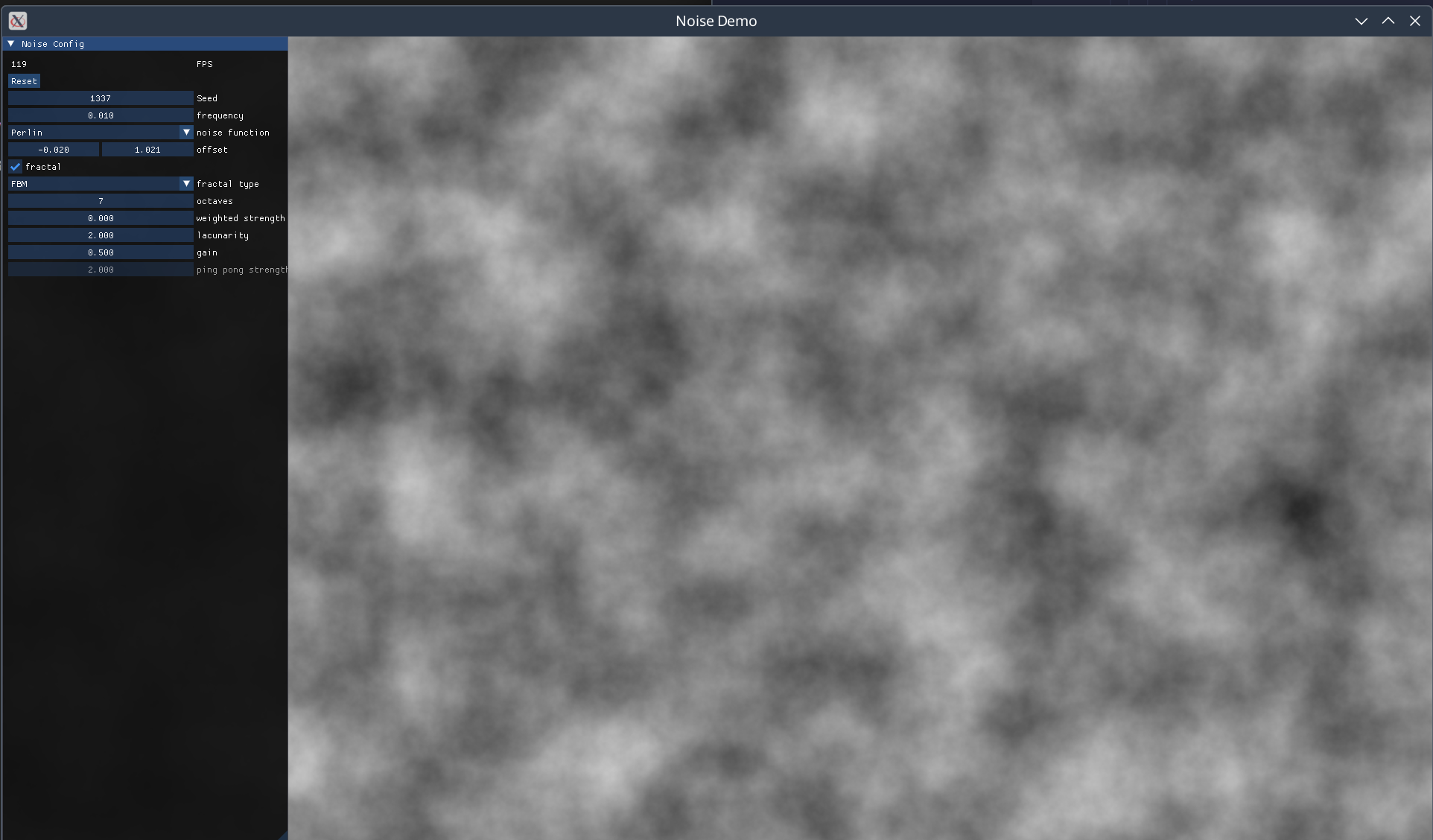
There's an interactive [demo app](https://github.com/jtnuttall/pure-noise/tree/main/demo) in the `demo` directory.
### OpenSimplex2
### Perlin
### Cellular