# Dear ImGui.hs
> Dear ImGui is a **bloat-free graphical user interface library for C++**. It
> outputs optimized vertex buffers that you can render anytime in your
> 3D-pipeline enabled application. It is fast, portable, renderer agnostic and
> self-contained (no external dependencies).
This project contains Haskell bindings to the
[ImGui](https://github.com/ocornut/imgui) project. This allows you to rapidly
put together graphical user interfaces in Haskell, with a particular focus to
games and graphics intensive applications.
# Getting Started
To get started, we'll build the following:
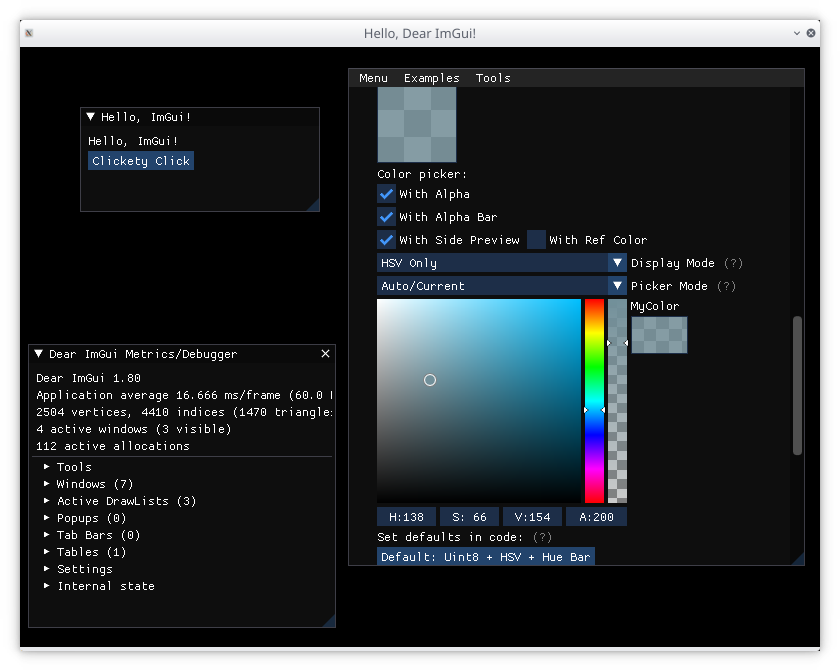
`dear-imgui.hs` can be used like a normal Haskell library. If you use Cabal,
add `dear-imgui` to your `build-depends`, together with the
`dear-imgui-impl-<backend>` package(s) for the platform and renderer backends
you want to use. For example, for a combination of SDL2 and OpenGL 3, plus the
`sdl2`, `gl` and `managed` packages the example below uses directly:
```
build-depends: dear-imgui, dear-imgui-impl-sdl2, dear-imgui-impl-opengl3, sdl2, gl, managed
```
With this done, the following module is the "Hello, World!" of ImGui:
``` haskell
{-# language OverloadedStrings #-}
module Main ( main ) where
import DearImGui
import qualified DearImGui.Impl.OpenGL3 as ImplGL3
import qualified DearImGui.Impl.SDL2 as ImplSDL2
import Graphics.GL
import SDL
import Control.Monad.Managed
import Control.Monad.IO.Class ()
import Control.Monad (when, unless)
import Control.Exception (bracket)
main :: IO ()
main = do
-- Initialize SDL
initializeAll
runManaged $ do
-- Create a window using SDL; as we're using OpenGL, we enable OpenGL too
window <- do
let title = "Hello, Dear ImGui!"
let config = defaultWindow { windowGraphicsContext = OpenGLContext defaultOpenGL }
managed $ bracket (createWindow title config) destroyWindow
-- Create an OpenGL context
glContext <- managed $ bracket (glCreateContext window) glDeleteContext
-- Create an ImGui context
_ <- managed $ bracket createContext destroyContext
-- Initialize ImGui's SDL2 backend
managed_ $ ImplSDL2.withInitForOpenGL window glContext
-- Initialize ImGui's OpenGL backend
managed_ $ ImplGL3.withInit Nothing
liftIO $ mainLoop window
mainLoop :: Window -> IO ()
mainLoop window = unlessQuit $ do
-- Tell ImGui we're starting a new frame
ImplGL3.newFrame
ImplSDL2.newFrame
newFrame
-- Build the GUI
withWindowOpen "Hello, ImGui!" $ do
-- Add a text widget
text "Hello, ImGui!"
-- Add a button widget, and call 'putStrLn' when it's clicked
button "Clickety Click" >>= \clicked ->
when clicked $ putStrLn "Ow!"
-- Show the ImGui demo window
showDemoWindow
-- Render
glClear GL_COLOR_BUFFER_BIT
render
ImplGL3.renderDrawData =<< getDrawData
glSwapWindow window
mainLoop window
where
-- Process the event loop
unlessQuit action = do
shouldQuit <- gotQuitEvent
unless shouldQuit action
gotQuitEvent = do
ev <- ImplSDL2.pollEvent
case ev of
Nothing ->
return False
Just event ->
(isQuit event ||) <$> gotQuitEvent
isQuit event =
eventPayload event == QuitEvent
```
# Raw access
The high-level `DearImGui` module covers the common widgets. Everything else is
reachable through the generated [`dear-imgui-raw`](https://hackage.haskell.org/package/dear-imgui-raw)
packages that `dear-imgui` is built on: one module per struct
(`DearImGui.Raw.ImGui`, `DearImGui.Raw.ImDrawList`, ...), plain `IO` functions
taking the full imgui argument list, and `OverloadedRecordDot` field accessors on
struct pointers (`poke io.iniFilename ptr`). Enum values live in per-enum
modules and are meant to be imported qualified:
``` haskell
import qualified DearImGui.Raw.Enums.ImGuiWindowFlags as ImGuiWindowFlags
flags = ImGuiWindowFlags.NoTitleBar .|. ImGuiWindowFlags.NoResize
```
Renderer/platform backends live in the `dear-imgui-impl-<backend>` packages.
Each one exposes a raw layer (`DearImGui.Raw.Impl.SDL2`,
`DearImGui.Raw.Impl.OpenGL3`, ...) working on raw pointers, plus a bridge
module (`DearImGui.Impl.SDL2`, `DearImGui.Impl.GLFW`, ...) that accepts the
`sdl2`/`GLFW-b` handle types, feeds SDL events to ImGui (`pollEvent`) and
provides `withInit*` brackets. For Vulkan, `DearImGui.Impl.Vulkan` covers the
descriptor pool and `ImGui_ImplVulkan_Init` boilerplate, for both render-pass
and dynamic-rendering targets.
# Hacking
If you would like to help `dear-imgui`, here's how you can get started.
The best path to development is using
[Nix](https://nixos.org/guides/install-nix.html). Once you have Nix installed
(either in your operating system, or by running NixOS), add the haskell.nix
binary caches to your `nix.conf` so you don't end up building GHC from source:
```
extra-substituters = https://cache.zw3rk.com https://cache.iog.io
extra-trusted-public-keys = loony-tools:pr9m4BkM/5/eSTZlkQyRt57Jz7OMBxNSUiMC4FkcNfk= hydra.iohk.io:f/Ea+s+dFdN+3Y/G+FDgSq+a5NEWhJGzdjvKNGv0/EQ=
```
Then you can enter a development shell:
```
$ nix-shell
```
You should now be in a `bash` shell where you can run `cabal build all`,
`cabal run readme`, etc.
If you experience any difficulties, please don't hesitate to raise an issue.
# Getting Help
Feel free to raise bugs, questions and feature requests on the GitHub issue
tracker.
We have a Matrix room at
[`#dear-imgui.hs:ocharles.org.uk`](https://matrix.to/#/#dear-imgui.hs:ocharles.org.uk).